- Read offline
- Access all content
- Use the in-app Map to find sites, and add custom locations (your hotel...)
- Build a list of your own favourites
- Search the contents with full-text search functionality
- ... and more!


beef cuts
French style
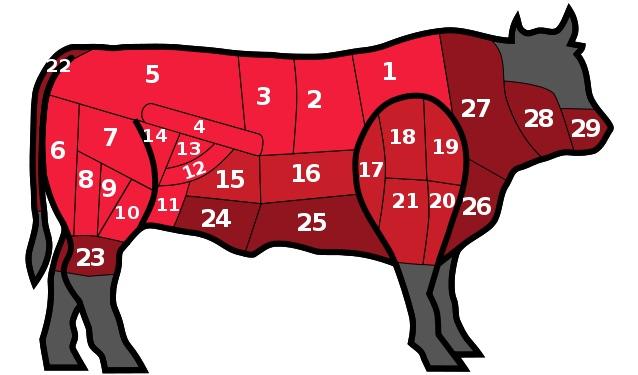
Every country has its own way of butchering. This chart may help you know what’s what at a French boucherie (the lighter the colour on the diagram, the choicer the cut).
-
Basses côtes: silverside or chuck steak
-
Côtes, entrecôtes: rib steak
-
Faux-filet: similar to sirloin
-
Filet: fillet, a quality beefsteak. The filet mignon (tournedos) is taken from the tip of the filet.
-
Rumsteck: rumpsteak
-
Rond de gîte: lean muscle, topside, or round in the USA; used for roast beef
-
Tende de tranche, poire, merlan: lean pieces. The tende de trache is good for roasting; poire and merlan are good for fondue or cooking in a wok.
-
Gîte à la noix: topside, thick flank steak, a cut often ground up for steak haché.
-
Araignée: fatty ‘spider steak’. There is also a ‘fausse araignée that looks the same and is recommended for a fondue Bourguignonne.
-
Plat de tranche, rond de tranche, mouvant: pieces to fry or grill
-
Bavette d'aloyau: loin
-
Hampe: skirt, described as a ‘butcher’s cut’ (morceaux du boucher—bits the butcher sets aside for special clients who appreciate it most)— a muscle that does little work, so very tender, good for the grill.
-
Onglet: hanger steak
-
Aiguillette baronne: long conical piece with a bit of fat, usually braised, fried or grilled; it toughens at high heat
-
Bavette de flanchet: flank steak
-
Plat de côtes: spare ribs
-
Macreuse à bifteck: often used for steak haché
-
Paleron: shoulder, good for braising. Also generally the part used to make steak à hacher – used for steak tartare.
-
Jumeau à bifteck: good for grilling or frying
-
Jumeau à pot-au-feu: like brisket, for soups and stews
-
Macreuse à pot-au-feu: like brisket
-
Queue: oxtail
-
Gîte: back shank, usually cut into chunks as bourguignon. Needs three to four hours to stew
-
Flanchet: the abdomen muscles, very good for flavouring a beef bouillon.
-
Tendron, milieu de poitrine: for stews such as boeuf bourguignon, pot au feu or ragoûts
-
Gros bout de poitrine: brisket. Because of its tough, connective tissue it is best slow cooked; it’s often used to make corned beef.
-
Collier: the neck, similar to gîte
-
Plat de joue: cheeks; deboned for a tête de veau
-
Langue: tongue; also goes into tête de veau, along with pieces of the snout.
Image by Graphic lab, GNU creative commons license